
What Lincoln County Property Tax Records Contain
Two Lincoln County offices split the work. The Lincoln County Assessor identifies current owners for assessment, values parcels, and tracks exemptions. The Lincoln County Treasurer collects the tax, records payments, and handles delinquency and tax-deed matters. Always check the year on each record before comparing any amounts.
| Field | What it documents | Where it is kept |
|---|---|---|
| Owner and parcel | Name on the roll and land being assessed | Assessor |
| Assessed value | Annual value assigned for tax purposes | Assessor |
| Exemptions or relief | Approved adjustment to taxable value or payment | Assessor |
| Bill and payments | Tax charged, balance, and collection history | Treasurer |
| Delinquency | Interest, costs, redemption, and hearing data | Treasurer |
Idaho assesses property at 100 percent of market value after exemptions. The yearly figure is still not a promise of what a buyer will pay. Nor does the bill establish clear title to the parcel.
Request a Lincoln County ProVal Report
Lincoln County offers no stable public parcel-card search. The Assessor's request form serves as the official route instead. It asks for the parcel number, the parcel address, and the owner, and offers a ProVal Property Valuation Report, another specified record, or an aerial parcel map. The local limit is firm: one parcel per form.
- Confirm the situs address and parcel identifier.
- Complete the Assessor records form for one parcel.
- Select ProVal and state the assessment year needed.
- Compare its owner, value, and exemption fields with the same year's bill.
Electronic delivery is the form's standard method. The first 100 black-and-white letter or legal pages come free. After that, the listed charge is $0.15 per page. Expect a response within three working days, or notice that more time is needed.
Note: A project spanning several parcels takes several forms. Lincoln County requires a separate Assessor request for each one.
Look Up a Lincoln County Tax Bill
The Treasurer page links to Point and Pay. That service works as a payment channel rather than a full searchable archive, so the bill you want may not appear on the screen. When it does not, request the bill, the payment ledger, and the delinquency status by parcel number and year. Written responses give you something to keep.
- Use the parcel number rather than a mailing address alone.
- Request the current bill and any earlier unpaid year.
- Match the value and exemption to the Assessor record for that year.
- Save a receipt separately from the original bill and ledger.
- Call the Treasurer at 208-886-7681 for a record the payment route does not expose.
- Assessed value
- The Assessor's annual value for taxation.
- Levy
- The rate applied by taxing districts.
- Tax relief
- An approved reduction or deferral for a qualifying applicant.
- Tax lien
- A claim arising from unpaid property tax.
Lincoln County Relief Has Record Deadlines
The county's 2026 property tax relief page states that applications open January 1. Property Tax Reduction and Veteran Benefit applications are due April 15. Property Tax Deferral applications are due September 8. Filing dates matter. They can explain why two similar assessments end with very different taxable outcomes.
The official county page is the place to confirm current eligibility before you gather forms.
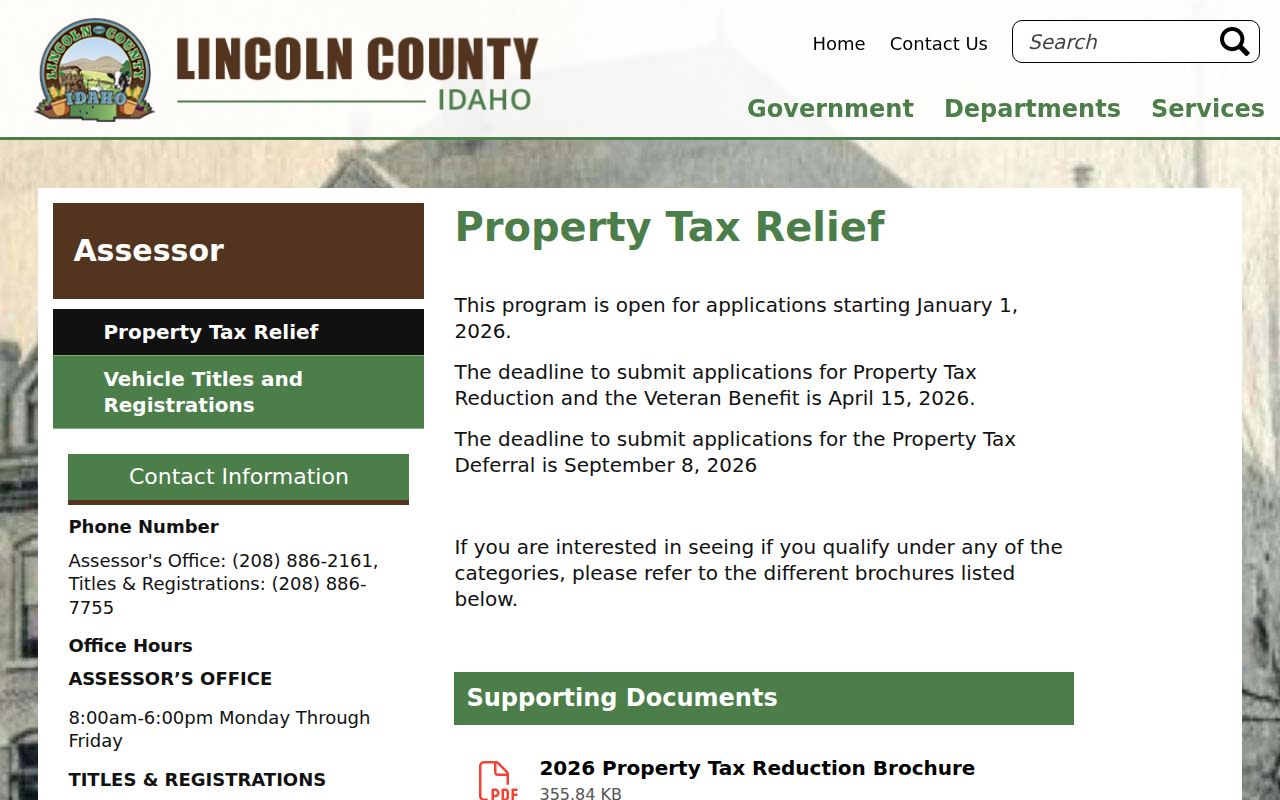
Program dates can change from year to year. Use the live county page rather than any saved copy.
Protect the deadline. File with the Assessor by the date stated for the program and keep proof of delivery.
Why Lincoln County Values and Sale Prices Differ
The Idaho State Tax Commission sets the market-value framework that Lincoln County assessments follow. Its ratio studies compare assessed values against verified sales across the county. The goal is to measure whether appraisal levels stay uniform from parcel to parcel. Keep in mind that a ratio study is broad. It never serves as an appraisal of a single Lincoln County parcel. The state's ratio-study page also adds helpful context on how those comparisons fit the wider property tax system.
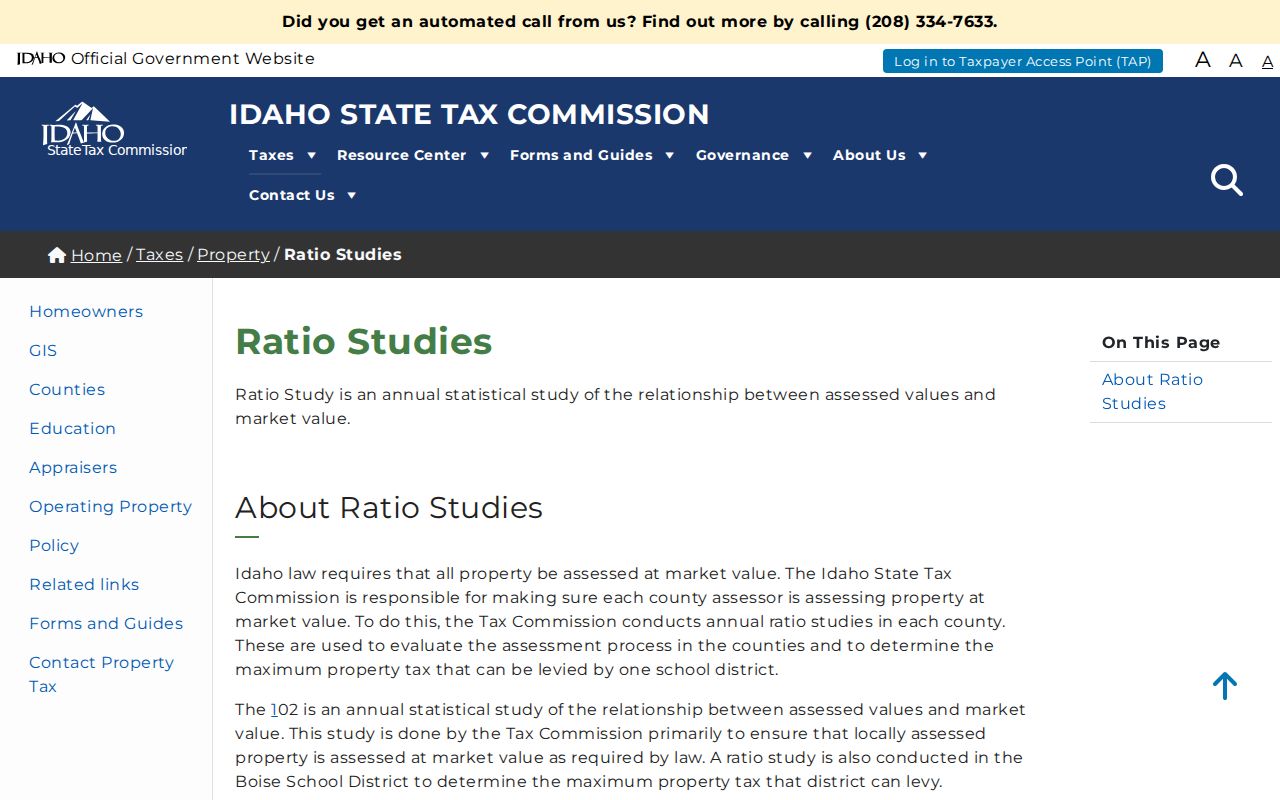
Treat the statewide explanation as background for reading a local ProVal record, not as a stand-in for parcel-specific evidence.
| Number | Meaning | Not the same as |
|---|---|---|
| Assessed value | Tax valuation for a stated year | Guaranteed selling price |
| Taxable value | Value after applicable relief | Full assessment in every case |
| Sale price | Consideration in a transfer | Annual assessment |
| Ratio result | Group measure of uniformity | Parcel appraisal |
A Lincoln County Tax Notice Is a Parcel Clue
The official 2025 tax-deed notice packs in owner, last-known address, parcel, situs address when present, and legal description. It also lists the tax, late charge, monthly interest, title or preparation costs, redemption deadline, and hearing information. Those exact strings can be carried into other Lincoln County records. Named descriptions include Sky High Estate, Riverside Pl, Green Cut Subdivision, Shoshone Townsite, Dietrich Townsite, and North Shoshone Tax 4 NENW 15-5-17. Preserve the spelling, lot, and block details exactly as printed. A notice proves the process reached the published stage. It does not prove the parcel was ultimately sold.
Check the outcome. Payment, redemption, postponement, or a later order can change the status after publication.
Appeal a Lincoln County Assessment Promptly
Start by verifying parcel characteristics, improvements, acreage, and exemption entries. Idaho's property-tax calendar places assessment notices and Board of Equalization work in the June cycle. The controlling date is the one on your current notice. So read the official property-tax calendar as soon as it arrives. Evidence tied to the parcel carries the most weight. That could be a recent arm's-length sale, well-matched sales adjusted for differences, an appraisal, dated photographs, measurements, or proof that a listed improvement does not exist. Keep the notice envelope and a date-stamped copy of your appeal.
Note: A payment dispute and a valuation appeal are separate matters. So send each record to the office that maintains it.
Correct a Lincoln County Roll Error
An incorrect address, owner, acreage, structure, or exemption entry starts with three details. These are the field, the parcel, and the year. A one-parcel request yields a cleaner record than a broad inquiry. When a recent deed conflicts with the tax roll, ask the Recorder. The Recorder can confirm the latest instrument. Lincoln County publishes no fixed deed-to-roll update interval. The Idaho Public Records Act, Idaho Code §§ 74-101 through 74-126, opens an access route. It covers nonexempt existing records. The county records request page explains how to submit locally. A request retrieves an existing record. It cannot oblige staff to create a new appraisal or legal conclusion.
Keep a Lincoln County Tax Research Packet
A Lincoln County tax packet works when each document keeps its own role. Save the ProVal report with its request date. Add the annual bill, any payment ledger or receipt, and exemption decisions. Delinquency raises the stakes. Then preserve the notice, redemption deadline, hearing information, and the document stating the outcome, plus the legal description from a recorded instrument whenever changed addresses create doubt.
Dates matter as much as names. Write down the assessment year and the tax year. Record each payment date, the request response date, and any deed recording date. That discipline keeps an old bill from being read as a current balance, and it reveals whether an ownership change, parcel split, new structure, or relief application fell between annual property records.
Keep the situs address for the land. Give the owner's mailing address its own field. A parcel number is usually the safest cross-reference, but pair it with the legal description whenever a split, combination, or replat looks possible. Ask the Assessor which record explains the change. Guessing from a tax map costs more time than a direct question.
Give a narrow date range for any in-person or mailed inquiry. Say what format you need. An ordinary copy, an electronic file, and a certified record are different requests. The courthouse at 111 W B Street in Shoshone houses the main county offices. A labeled packet helps when a question moves from Assessor to Treasurer or Recorder.
Limits of Lincoln County Property Tax Records
Tax records have firm limits in Lincoln County. They prove no surveyed boundaries, no clear title, no occupancy, no permit compliance, and no physical condition. Owner fields can lag a new deed. A mailing address may point to a trustee, a company office, or another correspondence spot, and for the difference between assessed, market, and sale figures the Lincoln County property value guide sorts it out.