
Read the Lincoln County Deed Type First
Read the deed type before anything else in a Lincoln County chain. The type tells you what the transaction actually did. The county Recorder files deeds alongside mortgages, deeds of trust, releases, liens, and plats. Those neighboring recordings often explain an ownership record. Even so, only a deed purports to convey an interest.
| Deed Type | What It Does | Common Use |
|---|---|---|
| Warranty deed | Conveys the stated interest with deed covenants | Ordinary arms-length transfer |
| Quitclaim deed | Conveys whatever interest the grantor possesses | Family transfer or correction of ownership |
| Trustee or personal-representative deed | Transfers through a trust or estate role | Trust administration or probate |
| Sheriff's deed | Follows a court-authorized sale process | Foreclosure enforcement |
| Tax deed | Follows statutory delinquent-tax proceedings | Property acquired after tax enforcement |
Mortgages, liens, assignments, and reconveyances record claims or their release. They do not name a new owner. Follow the full instrument sequence rather than treating every party as a buyer or seller.
Where Lincoln County Deeds Are Recorded
The Lincoln County Clerk serves as Ex-Officio Auditor/Recorder at 111 W B Street in Shoshone. On the recording page, Simplifile and 800-460-5657 appear as an electronic submission channel. That service accepts documents for recording. It is not a public historical grantor-grantee index.
The county publishes no stable public deed-index URL. There is no field list, image-fee schedule, or earliest online year. The practical route is a focused clerk request. Include the parcel or address. Add the legal description, grantor, grantee, document type, and date range. Missing a portal is a reason to sharpen the request. It does not mean Lincoln County deed records are unavailable.
View the official Lincoln County recording page for office and e-recording details.
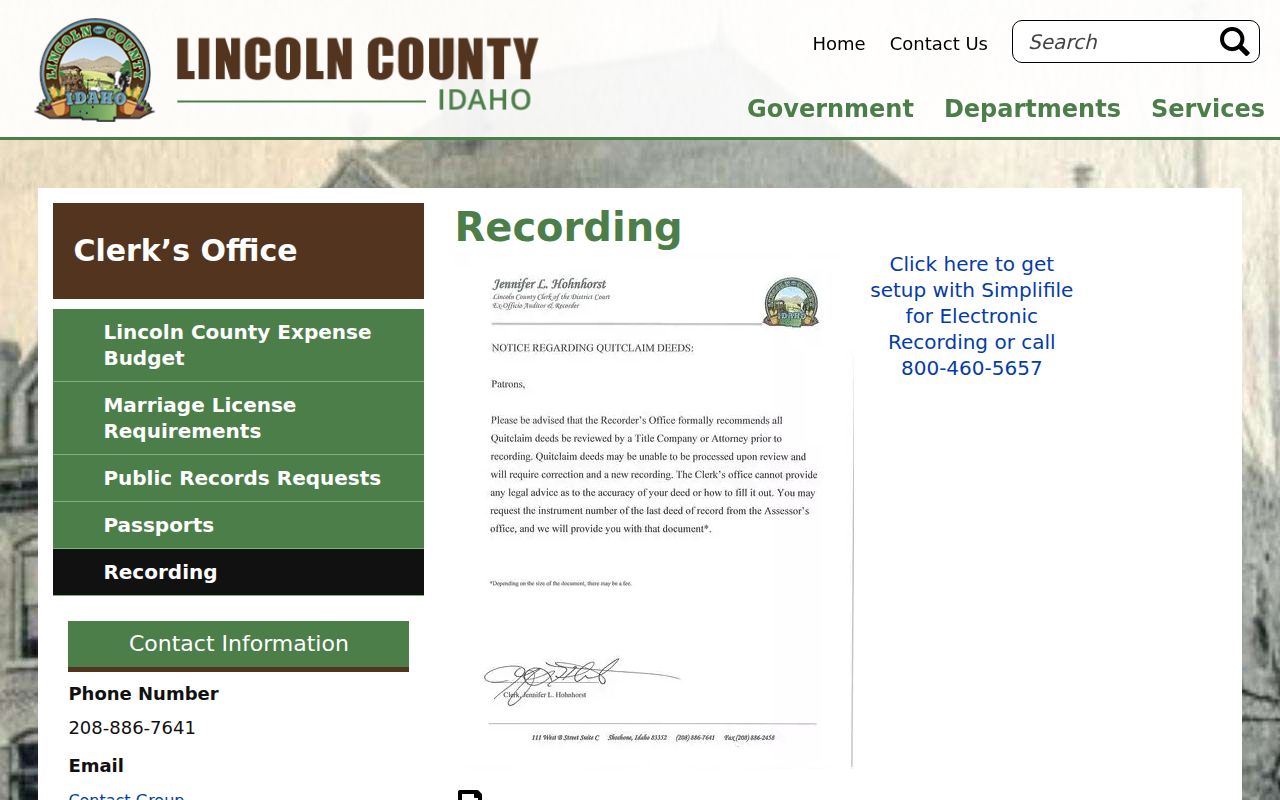
The county page confirms the recording office and the e-recording route. Historical public searching stays with clerk-assisted access.
Walk Lincoln County's Deed Chain Backward
Start a backward chain from the newest reliable deed reference, not a broad surname hunt. The current grantee then becomes the party you search as grantee in the earlier acquisition. Repeat that step at each transfer. Keep the legal description constant enough throughout to separate namesakes and multiple holdings.
- Find the current owner's acquiring deed, where that owner appears as grantee.
- Copy the grantor, recording date, document type, book/page or instrument number, and full legal description.
- Search the grantor as an earlier grantee and verify that the property description matches.
- Repeat through correction, estate, trustee, sheriff, and tax instruments rather than skipping non-sale transfers.
- Bridge beyond available digital material through clerk-held books, plats, and historical images.
- Grantor
- The party transferring the stated interest.
- Grantee
- The party receiving the stated interest.
- Chain of title
- The connected sequence of transfers affecting the same land.
- Book/page or instrument number
- A locator assigned to the recorded document; preserve whichever reference appears.
Use Lincoln County Legal Descriptions as Anchors
Street addresses get assigned, abbreviated, and changed. A legal description carries the chain far more reliably. A 2025 county tax-deed notice shows the local vocabulary: Sky High Estate Lot 13, Riverside Pl Lots 3–8, Green Cut Subdivision Lot 1 Block 2, Shoshone Townsite blocks, Dietrich Block 57 lots, and North Shoshone Tax 4 NENW 15-5-17. Treat those as examples, not a full subdivision index.
For platted land, keep the townsite or subdivision name, block, lot, plat book and page, plus any replat. For rural parcels, hold onto section-township-range, quarter-section, acreage, and adjoining-owner calls. Run the same strings through GIS subdivision and deed/plat fields, recorded plats, court files, and legal notices.
Easements, mineral reservations, water rights, rights-of-way, and life estates can sit inside the deed text itself. A simple owner result may omit them. Read the instrument image and any exhibits it references.
The 1886–1972 Image Backstop
Idaho, Lincoln County Records, 1886–1972 holds images digitized from Clerk of District Court material in Shoshone. It also draws on Clerk/Recorder material. Its Browse All collection spans 164,360 images. You get deeds, patents, probate files and registers, vital records, coroner inquests, and military discharges.
The 1972 endpoint is a digitization boundary, nothing more. It does not show that recording stopped then. Nor does it mean the current index begins in 1973. Indexing there can be incomplete, so browse adjacent images and check book/page labels by hand. Bridge newer or missing material through the Recorder.
For context around an old transfer, the University of Idaho newspaper microfilm finding aid lists the Shoshone Journal from 1891–1931, a 1902 Shoshone Independent entry, the Southern Idaho Democrat from 1915–1916, and scattered Lincoln County Journal runs. A legal notice near the instrument date can explain a probate, tax, or sheriff transfer. It supplements the deed rather than replacing it.
A Family Burial Ground Can Leave a Deed Clue
Lincoln County Family Burial Ground Ordinance 2024-03, recorded as Instrument #209476, requires a qualifying burial ground to be fenced or marked. It must also be described by metes and bounds or otherwise noted on the deed before interment. The obligation runs with the land and its successors. No searchable interment database exists. Even so, the burial-ground lead stays relevant to deed records.
Ask the Recorder for the recorded description. Then inspect the parcel's deed, easement, and land-use history. The rule shows why a chain is more than sale dates. Recorded restrictions and obligations can shape later ownership.
Request Fields That Help the Recorder Find a Deed
The general county request form asks for requester contact information and detailed subject matter. It also wants a date range, and a case number when relevant. Person-specific records add fields for name, date of birth, and address. For land research, go further. Add the parcel number and complete legal description. Include grantor and grantee name variants, deed type, and any known book/page or instrument reference.
| Party clues | Grantor, grantee, trustee, estate, personal representative, and entity-name variants |
|---|---|
| Land clues | Parcel, situs, subdivision or townsite, lot/block, and rural legal description |
| Time clues | Estimated signing/recording dates and a practical range |
| Output | Index entry, image or copy, certification if needed, and delivery preference |
Delivery options are email, U.S. Mail, requester-supplied storage media, or pickup. Send requests to Lincoln County, 111 W B St., Shoshone, ID 83352, Attn: Records Office, or email clerks@lincolncountyid.us, or fax 208-886-2798. Call 208-886-7641 when the correct book or document class is unclear.
Obtain a Lincoln County Deed Copy
Decide first whether an informational image will serve or whether the deed must be certified. Either way, ask for every page. Attached exhibits and recording stamps belong with the copy too. Lincoln County publishes no Recorder fee schedule for deed copies. Confirm the cost before ordering. The District Court's separate rates, a dollar per page and a dollar per seal, apply only to court documents.
The county documents several ordering channels. You can use the courthouse counter. Mail works too, as does an email request, fax, or pickup and electronic delivery. For historic images, FamilySearch offers online consultation. The Idaho State Archives serves as another finding aid and reading room for transferred government records. Neither route substitutes for certification by the current custodian.
Recorded, not guaranteed. Lincoln County deed records show instruments accepted for recording, not a legal opinion that title is clear. Unrecorded interests, corrections, competing descriptions, and later filings may affect the result.