
Compare Lincoln County Property Value Types
Idaho assesses property at full market value, minus any exemptions that apply. That still does not make the numbers interchangeable. A sale price belongs to a single deed. The assessed value drives the county's annual tax process, while a taxable figure reflects relief applied, and only the recorded transfer amount speaks for its own transaction.
| Value | What It Is | Where |
|---|---|---|
| Assessed value | County value developed for assessment | Assessor parcel or ProVal report |
| Taxable value | Value remaining after applicable exemptions or relief | Assessment and tax material |
| Recorded sale evidence | Consideration or sale context tied to a transfer | Deed, transfer record, or GIS sales link |
| Market appraisal | Opinion for a specific property and effective date | Independent licensed appraisal |
Assessed value and sale price diverge for a reason. Each answers a different question, often on a different date. A deed can also carry odd terms. Idaho ratio studies test whether assessments track sale prices across groups, so one Lincoln County parcel's assessment is never promised to equal its next price.
Request a Lincoln County ProVal Report
The Lincoln County Assessor values property, tracks current owners, and administers exemptions. Its records form does the rest. You supply a parcel number, a parcel address, or an owner name. Then you choose your product. Options include a ProVal Property Valuation Report. An aerial parcel map is another choice, or you can name a different record. One parcel per form, though. That limit rewards precision, so include the complete parcel ID and the assessment year you need. Electronic delivery is the default. The first 100 black-and-white letter or legal pages are free, and a per-page charge follows, with response or extension language built into the form.
Place Lincoln County Values in the Annual Cycle
Every value sits on a date. Idaho ties annual valuation to January 1. A later remodel, demolition, or sale does not quietly rewrite the year. The assessment record keeps the year it was stamped with. Keep the value year and the retrieval date side by side.
Lincoln County publishes no fixed roll-refresh interval after a deed. So owner and value can share one parcel report. Yet they may reflect different administrative events. A recent deed can be strong evidence of ownership. But it does not serve as a fresh appraisal of present value.
Note: Compare years and source dates before calling two Lincoln County value figures a disagreement.
Estimate a Lincoln County Property Value Record
Start with the address you know. But make the parcel number your lasting key. Lincoln County's GIS documentation covers address, owner, parcel, neighborhood, assessed-value, and sales searches, and parcel detail links out to a Property Record Card, Land Report, and Sales History. The live viewer link can be temperamental, so launch it from the Assessor page instead.
- Convert the address to an exact parcel ID through the county GIS route.
- Request or open the parcel's current ProVal report and capture its year.
- Separate assessed, taxable, land, improvement, and exemption fields that actually appear.
- Check Sales History or the recorded deed for dated transfer evidence.
- Use ratio-study context for broad assessment comparison, not a parcel appraisal.
- Assessed value
- The county's value for the assessment system.
- Market value
- The value concept Idaho uses in its full-value framework.
- Assessment ratio
- A comparison of assessed values with sale evidence across property groups.
- Consideration
- The amount or value recited for a transfer, which may need context.
- Reassessment
- A later valuation action, distinct from a private appraisal.
Use Idaho Ratio Studies with Lincoln County Values
The Idaho State Tax Commission ratio-study material explains how the state measures assessment level and uniformity against valid sale prices. It is a quality-control and equalization tool. A countywide ratio is not a sale prediction. For one Lincoln County parcel, the official ratio-study page still supplies only statewide comparison context.
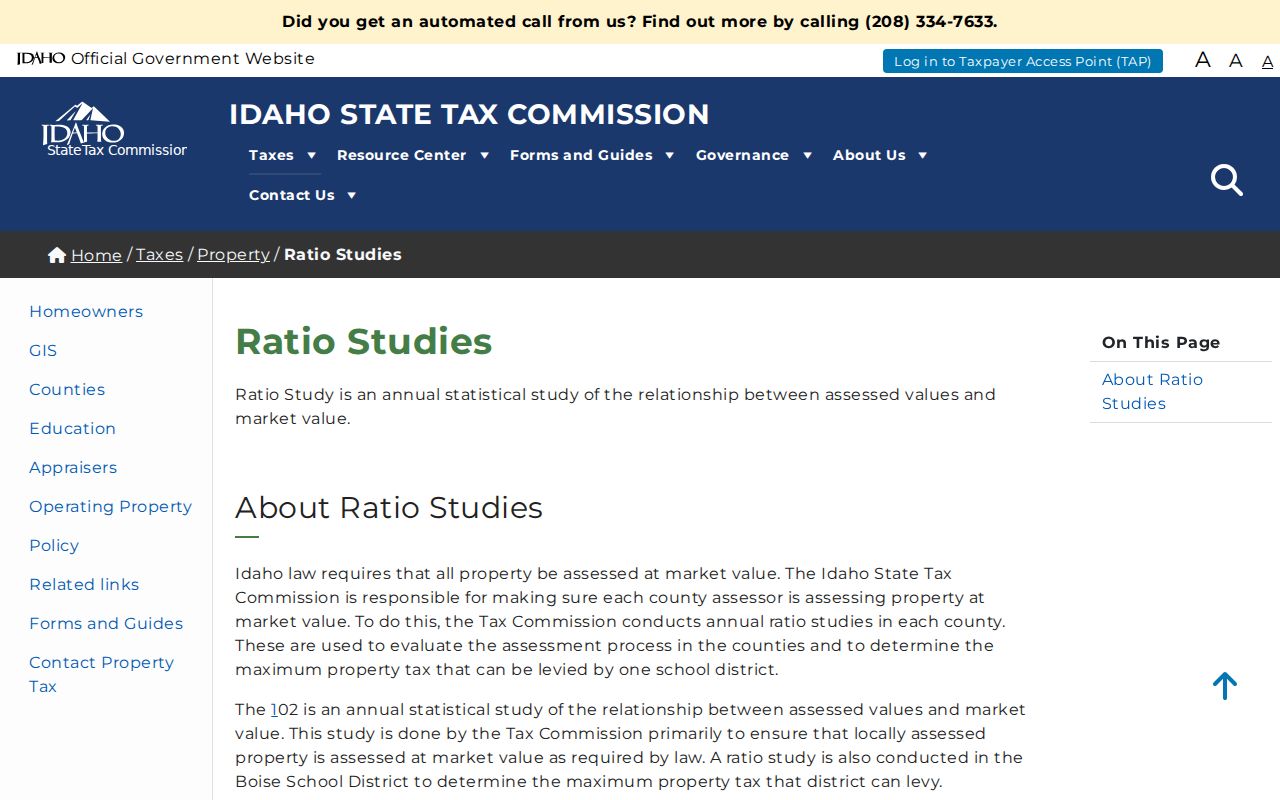
The ratio studies support assessment-level review. They do not deliver a parcel-specific appraisal. When a value seems far from a recent sale, first align the assessment year, transfer date, parcel configuration, and property interest sold. Then judge whether the sale suits comparison at all. Never multiply a public ratio by an assessment and present the product as an appraisal.
Separate Lincoln County Sale Evidence from Assessment
Lincoln County's GIS help documents a Sales Search with numeric assessed-value input. Links tie each sale to the present parcel. A recorder instrument may add grantor, grantee, date, legal description, and consideration. The county publishes no stable public deed index. A clerk request may be needed. A recorded amount can mean more or less than an arm's-length purchase of the current parcel. Family transfers, partial interests, bundled land, corrections, and non-sale deeds all require care, so match the legal description first. Read the deed itself before trusting the figure.
Understand Relief in a Lincoln County Value Record
Relief programs change the taxable result, not the market value behind it. Lincoln County's property-tax relief page lists four routes. Homeowner, Property Tax Reduction, veteran, and deferral programs each work differently. The 2026 cycle opened January 1. Published deadlines fall in April and September, depending on the program. That is why two fields on one record can disagree. Questions about a bill, a relief application, payment, or an assessment challenge belong with the Assessor or Treasurer and the county's property-tax guide.
Preserve Lincoln County Value Evidence
A strong comparison packet earns its keep. Include the parcel ID, situs, legal description, and dates. Add the assessment year, the retrieval date, every labeled value field, each exemption line, and any dated sale evidence. Save the full parcel report rather than copying a single number. The GIS print function produces PDFs. Export preserves selected fields, though full parcel detail may outgrow a CSV. Never read population growth as countywide appreciation. And keep demographics, zoning, parcels, sales, and assessments in separate columns until their dates and definitions line up, since an assessor neighborhood is not a recorded subdivision.
Know What Lincoln County Assessed Value Cannot Say
The assessor's property value serves public assessment administration. It was never built for deal-making. A mass-appraisal figure does not inspect features for a pending transaction, guarantee a buyer's offer, establish replacement cost, or settle a disputed boundary, so a licensed appraiser should develop the property-specific opinion for a stated purpose and date.
Value is not price. A Lincoln County assessed value is not what the property will sell for and is not a private appraisal.
Tax questions go to one place. For the tax bill, exemption process, or appeal calendar, use the Lincoln County property tax records guide. A sale decision calls for more. Combine official property records with current physical information and qualified valuation advice.
Apples need to match apples. Normalize the data before comparing two Lincoln County parcels. Use the same assessment year. Identify whether each figure covers land, improvements, or both, and note each exemption separately. Confirm that both records describe the same property class and current parcel configuration. A split, merger, new structure, demolition, or change in use can make a side-by-side comparison misleading. This holds even when the arithmetic checks out.
The assessor neighborhood field groups parcels for mass appraisal, but it is not automatically a subdivision, association, or market boundary. The GIS layer called Tax Parcel Neighborhoods supplies assessment context. A recorded plat and legal description answer different questions. Treat the neighborhood code as one input, and do not claim it defines a buyer's comparable-sales area.
Sales evidence needs its own quality check. Confirm the transfer date, the parties, the legal description, and the property interest. Also confirm whether the parcel existed in its current form. A quitclaim, estate transfer, correction, or deed covering several tracts may carry consideration that cannot be compared directly with the assessed value. The Recorder remains the source for the instrument. The GIS sales link is a route to investigate it.
Physical and regulatory context can explain differences without producing a new value figure. Lincoln County GIS documents flood, soil, zoning, utility, water, road, building-footprint, and aerial layers. These are starting points, not adjustments for a homemade formula. Context is not a valuation. A flood overlay is not a final determination. A utility line does not promise service. A building footprint can lag recent work.
Preserve uncertainty where the county leaves a gap. That gap is real. Lincoln County publishes no stable public parcel-card search URL and no live parcel results. There is no confirmed sale-price field and no fixed roll-update interval. Those absences call for a parcel-specific Assessor request and, when needed, a Recorder request. They do not justify inventing a coverage date, sale amount, or refresh schedule.
Public tax-deed notices offer another dated value context, though never a market appraisal. Lincoln County's 2025 notice itemized parcel, address, record owner, legal description, tax due, late charge, interest, and title or preparation costs. Those amounts explain a delinquency process. Read them as process, not price. Never add them together and present the total as the land's value or likely sale price.
County relief dates belong to the program year. For 2026, the Assessor set an April deadline for Property Tax Reduction and Veteran Benefit applications. It set a September deadline for deferral. Timing may explain whether a taxable figure reflects relief. It does not imply a countywide revaluation or any change in market value.