
Trace Lincoln County Former Owners by Era
The Lincoln County Clerk serves as Ex-Officio Auditor and Recorder. The office holds current deeds, mortgages, releases, liens, and plats. The public recording page posts no grantor-grantee index. No earliest searchable year appears there either. Recent previous owners therefore call for a direct clerk request. The strongest online backstop is FamilySearch's Lincoln County collection. It is described as holding deeds, patents, probate, vital, court, and related images from 1886 through 1972.
| Source | Years It Covers | Where Held | What It Shows |
|---|---|---|---|
| Recorder instruments | No public cutoff verified | Clerk/Recorder, Shoshone | Grantor, grantee, description, reference |
| County image collection | 1886-1972 described | FamilySearch | Deeds, patents, probate, related images |
| Recorded plats | Ask by townsite or subdivision | Recorder and GIS clues | Lots, blocks, replats, parcel origins |
| Newspaper microfilm | Named runs include 1891-1931 | University of Idaho | Sale, tax, probate, and plat notices |
The current deed comes first. It names the first prior owner. It also carries the legal description that will not drift, so use the recording office for the modern chain and the 1886-1972 collection whenever references fall inside its range. The Idaho State Archives can say whether a needed book or roll was transferred or microfilmed.
Carry Lincoln County Legal Descriptions Back
Street addresses make weak time keys. Lincoln County notices mix Shoshone Townsite blocks, Dietrich Townsite lots, Sky High Estate, Riverside Place, Green Cut Subdivision, and rural section-quarter wording. Copy every word and number from the newest deed. A lot and block can outlive a street-number change. Township, range, section, quarter-quarter, and acreage can anchor farm land through later parcel splits.
Official parcel IDs vary in length and punctuation. Never guess at prefix meanings. Keep the full ID intact, but match on the deed or plat description. When a split, merger, or replat appears, compare both legal descriptions before treating the next instrument as the same tract.
Request Lincoln County's Unindexed Deeds
No public index appears, so the clerk's general records form is the practical route. Name every grantor and grantee variant. Add parcel, description, instrument type, and dates. Requests may go to clerks@lincolncountyid.us or the Records Office, 111 W B Street, Shoshone, ID 83352. Delivery options include email, mail, and pickup. The official Lincoln County recording page confirms the Recorder and the electronic-filing route for submitters.
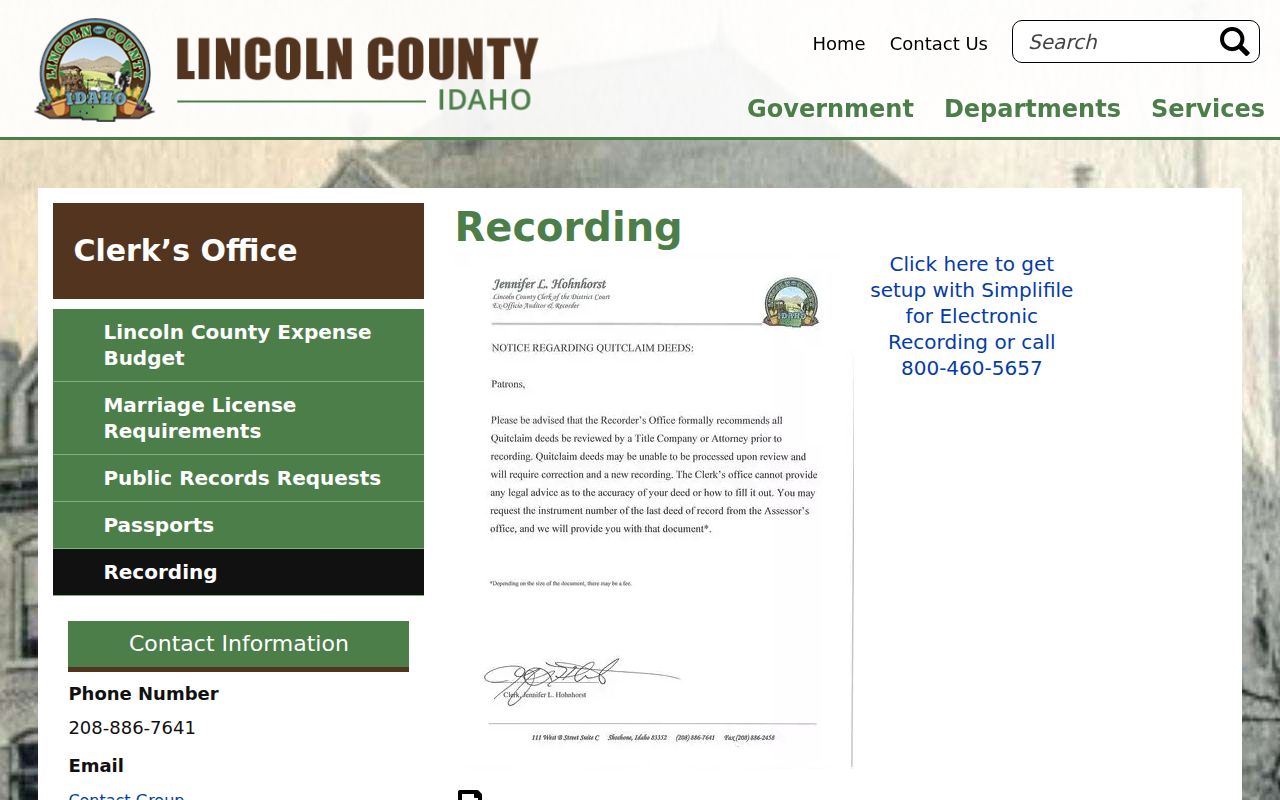
The county publishes no public historical index online. Simplifile is an electronic recording channel for submitters, not a public ownership archive. An empty web search proves nothing. A missing deed may still sit in the books. Ask the custodian to check the named parties and the land description.
Walk Lincoln County's Deed Chain Backward
Every deed names the next search name. The seller becomes the grantor you chase next. Keep a transfer table with dates, parties, deed type, recording reference, and legal description so gaps and same-name errors stay visible.
- Find the newest deed and note its grantee, grantor, date, and description.
- Search that grantor as an earlier grantee on the same land.
- Add correction deeds, quitclaims, estate deeds, and other non-sale instruments.
- Repeat until access ends, then carry the last book/page into historical images or deed books.
- Grantor / grantee
- The transferring and receiving parties named in an instrument.
- Chain of title
- The ordered sequence of instruments affecting the land.
- Reverse index
- An index arranged by grantor for working backward.
- Quitclaim / warranty deed
- Different conveyance forms that must be read on their own terms.
Bridge Lincoln County Probate Transfers
A death can interrupt a sale-to-sale chain. Search Fifth Judicial District probate material for the estate. Look also for the personal representative, the decree, and any later deed. Idaho iCourt may supply case information. The documents remain clerk or courthouse-kiosk material under ICAR 32. Historical probate images also sit inside the FamilySearch collection's described range.
Keep probate order and deed separate. An heir named in a case does not always become the final grantee. A personal representative may sign solely for the estate. Newspaper probate notices can narrow the dates.
Match Lincoln County Plats to Prior Owners
A plat explains why one old tract later became several lots. GIS documentation offers subdivision and lot searches, deed book and page, plat book and page, and Historical Deeds. Treat those tools as finding aids. When an alley, canal, road, easement, split, or merger matters, compare the recorded plat itself.
The 2025 tax-deed notice supplies useful local search strings. It is not a complete subdivision roster. Its last-known owner address is dated contact information. It is not independent proof of the ownership chain. Read the underlying recorded instrument.
Note: A correction or replat can alter a description without creating a new former owner.
Use Lincoln County Newspapers as Date Clues
The University of Idaho's newspaper microfilm inventory preserves Shoshone titles and runs. It includes material from 1891 through 1931. Search near a deed, tax sale, probate appointment, subdivision approval, or sheriff notice date. Notices can reveal hearing dates. That detail makes a records request precise.
A newspaper corroborates but does not convey title. Pair the article or legal notice with the deed, the probate order, or the recorded plat. This helps most when spelling changed or a townsite description replaced an everyday street address.
Measure Lincoln County Ownership Time Depth
The documented online range runs 1886 to 1972. That does not mean every book starts in 1886, every image survives, or every instrument is indexed. Nor does it mean every parcel is indexed. No courthouse-fire account, destroyed-book list, digital cutover year, or current index start year is published. Preserve those unknowns.
Access limit. No verified earliest year exists for a current public county index. Older previous owners may require deed books, historical images, clerk help, or archives.
The trail may end at a patent. It may end at an earlier jurisdiction. Or it may hide in an unindexed volume. Treat that as a research boundary, not proof of first ownership; former-owner material serves house history, estate work, and land diligence. Never use it to track or harass a living person. Build a table first, not a narrative. Each instrument gets one row. Record execution and recording dates, grantor, grantee, deed type, book-page or instrument number, and the exact legal description. Note any name change through marriage, an estate, a trustee, or an entity. A table exposes a missing acquisition deed fast. It also shows when a description quietly shifts to another lot.
Never skip non-sale instruments. A quitclaim can settle an interest without a normal purchase. A correction can repair a misspelled name or a flawed description. A release may point to an encumbrance rather than ownership. Probate orders and personal-representative deeds can bridge a death in the chain, so read the parties and legal effect before counting anyone as a previous owner. Lincoln County's request form rewards narrow facts. Include both party-name variants, a date range, parcel ID, legal description, and any known recording reference. The form asks for contact and delivery details and permits email, mail, pickup, or requester-supplied media. If the clerk cannot locate the record, ask whether the reference sits in an older book, an earlier jurisdiction, or a transferred archive series.
GIS historical-deed and book-page links speed up the work. They are finding aids, though. Preserve the map date and parcel detail, then verify the instrument with the Recorder or a historical image. GIS data is compiled from recorded deeds, plats, tax maps, surveys, and public records and may contain errors. A parcel polygon does not prove the same boundaries existed at every point in the former-owner timeline. Chains reaching 1972 or earlier deserve a FamilySearch catalog search using the last known parties and book reference. For gaps, contact the Idaho State Archives. Ask whether deed books, tax rolls, court registers, naturalizations, or poll books were transferred or microfilmed. The absence of an internet index proves nothing. A paper volume may still exist.
Historical census records add occupancy and household context to a property chain. They never replace a deed. The National Archives releases individual schedules after 72 years, so the public record runs through 1950; later schedules stay closed. The 1890 census is mostly lost apart from fragments. Test a historical hypothesis with census names, then rely on recorded instruments for the chain. Keep negative findings precise. "No result in the public web page" differs from "the Clerk found no instrument," and both differ from a missing volume. Record the database, search terms, date range, and date searched. That habit keeps an access gap from becoming a false claim that Lincoln County ownership records ended or were destroyed.